How AI Is Changing the Way Modern Businesses Operate

 Oct 17,2026
 By admin
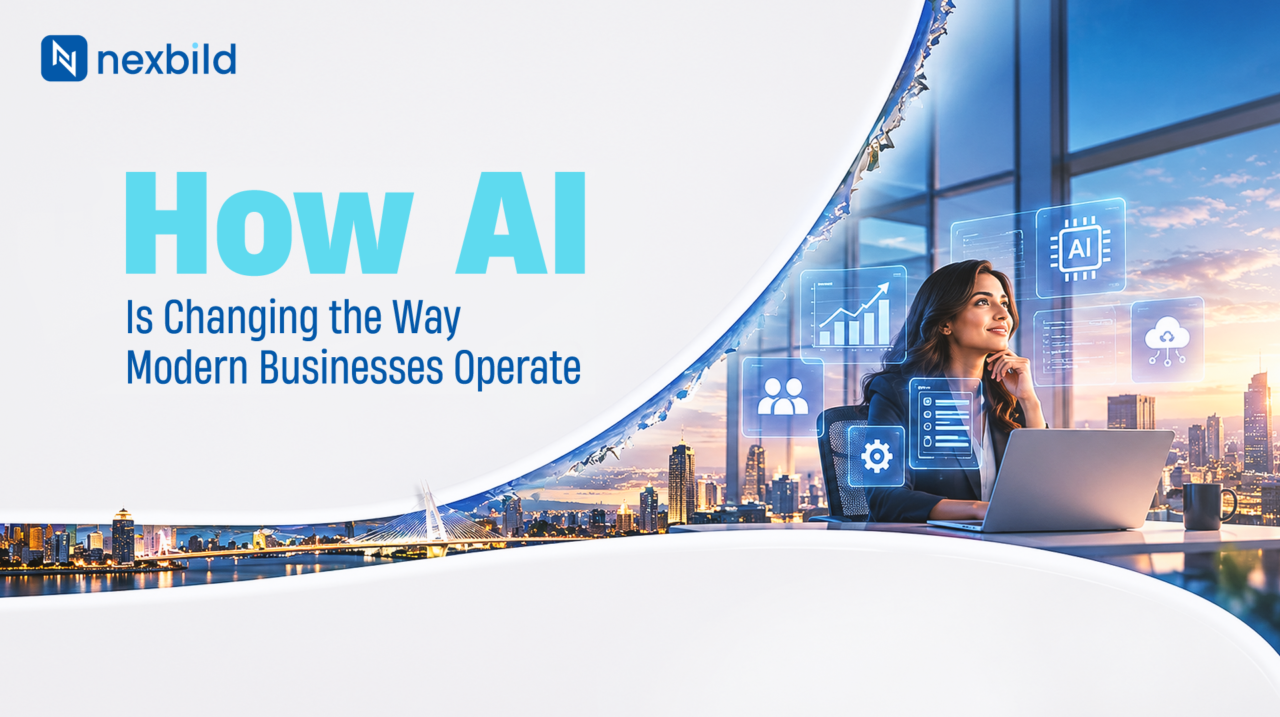
AI is changing modern business operations by taking over repetitive work (data entry, scheduling, support replies, reporting), turning raw data into forecasts and recommendations, and letting small teams deliver the speed and service that once required large ones.
The businesses getting real value are not the ones that bought the most tools. They are the ones that connected AI to specific workflows, measured the result, and kept humans in charge of judgment.
Key takeaways
- AI automation for small business is now affordable and practical, because cloud tools and AI-powered software no longer need an in-house data science team.
- AI for business works best when it targets one painful workflow first, such as HR, support, invoicing, or reporting, instead of a company-wide overhaul.
- AI business solutions deliver the most value when they are integrated into the systems a team already uses, whether off-the-shelf or custom-built.
- Adoption is widespread, but proven return is still uneven. Workflow design matters more than the tool itself.
What Does “AI for Business” Actually Mean?
AI for business means using artificial intelligence (machine learning, natural language processing, and generative AI) to perform, assist, or improve tasks inside a company. Examples include a chatbot that answers customer questions, software that reads invoices, a model that forecasts demand, or an assistant that tells an employee how many leave days they have left.
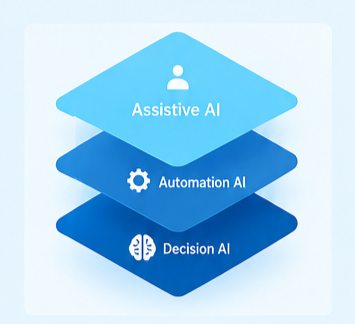
It helps to think of business AI in three layers:
- Assistive AI: tools that help people work faster, such as drafting emails, summarizing documents, or searching company knowledge.
- Automation AI: systems that run a process end to end with rules and learned patterns, such as routing support tickets or processing payroll.
- Decision AI: models that analyze data and recommend or make choices, such as demand forecasting, fraud flags, or route optimization.
Most small and mid-sized businesses start in layers one and two, then move to layer three once their data is clean and connected.
How Widespread Is AI in Business Right Now?
Very widespread, but not yet very mature.
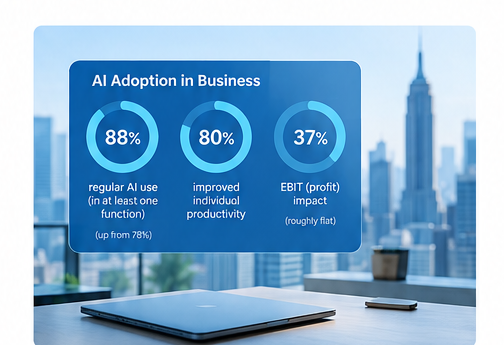
- McKinsey’s State of AI research found that 88% of organizations reported regular AI use in at least one business function in its November 2025 wave, up from 78% a year earlier.
- In McKinsey’s 2026 survey, 80% of respondents who use AI in their roles said it improved their individual productivity.
- Yet only 37% of respondents attributed any EBIT (profit) impact to AI, roughly flat from the previous year.
- McKinsey also reported that adoption and scaling among smaller organizations has stayed comparatively flat, which signals an opening for small businesses that adopt thoughtfully.
What this means: using AI is no longer the differentiator. Using it well, inside redesigned workflows with clear goals, is.
How Is AI Changing the Way Businesses Operate? 7 Key Shifts
1. Repetitive work is being automated
Administrative tasks like scheduling, data entry, invoice handling, onboarding paperwork, and status updates used to eat hours every week. AI automation now handles much of it with little supervision. For a ten-person company, that can mean the difference between an owner doing admin at night and an owner talking to customers during the day.
2. Customer service is available around the clock
AI chat assistants answer common questions instantly, outside business hours, and in multiple languages, then hand complex cases to a human with the context already attached. Customers get faster answers, and staff spend time on problems that actually need judgment.
3. Decisions are based on data, not guesswork
AI-driven dashboards and forecasting highlight which products are selling, where cash flow is tightening, and which projects are drifting off budget. Owners can move from “I think” to “the data shows.”
4. HR and people operations are becoming self-service
Attendance, leave, payroll, and records used to require a person to look things up. AI assistants now answer routine employee questions directly, so HR can focus on hiring, culture, and compliance.
5. Operations are becoming predictive
Instead of reacting to problems, businesses can anticipate them: low inventory before a stockout, maintenance before a breakdown, delays before a deadline slips. Predictive analytics is turning operations from reactive to proactive.
6. Marketing and sales are more personalized
AI helps segment audiences, draft content, score leads, and time follow-ups. A small team can run campaigns that once needed a full marketing department, as long as a human reviews the output for accuracy and brand voice.
7. Software itself is becoming AI-native
The most important shift is structural. AI is no longer a separate tool bolted on at the end. It is being built into the core software that runs payroll, projects, properties, and field operations, so the intelligence is where the work already happens.
AI Automation for Small Business: Where to Start
AI automation for small business is the use of AI-enabled software to handle repetitive, rules-heavy, or data-heavy tasks without hiring more staff. Small businesses benefit most because every hour saved goes directly back into growth or customer relationships.
Highest-ROI areas for small businesses
| Business Area | What AI Automates | Typical Benefit |
| Customer support | FAQs, ticket routing, after-hours replies | Faster response, fewer repetitive tickets |
| HR and payroll | Leave and attendance queries, payroll runs, records | Less admin time, fewer errors |
| Finance and invoicing | Invoice capture, reconciliation, anomaly flags | Fewer manual mistakes, cleaner books |
| Sales and CRM | Lead scoring, follow-up reminders, summaries | Higher conversion, better pipeline visibility |
| Operations | Scheduling, inventory alerts, reporting | Fewer surprises, smoother workflows |
| Marketing | Drafting, segmentation, scheduling | More output from a small team |
A simple rule for picking your first use case
Choose a task that is frequent, repetitive, and clearly measurable. If a person does it more than five times a week and you can count the minutes it takes, it is a strong candidate.
AI Business Solutions: Off-the-Shelf vs. Custom
AI business solutions are software products, integrations, and services that apply AI to a specific business need. There are two main routes.
Off-the-shelf (pre-made) solutions are fast to launch, lower in cost, and proven. They are ideal when your process is fairly standard, such as payroll, HR records, or basic support automation.
Custom AI solutions are built around your exact workflow, data, and systems. They make sense when your process is unusual, when you need to connect several tools through APIs, or when the workflow itself is a competitive advantage.
| Factor | Off-the-Shelf | Custom-Built |
| Speed to launch | Days to weeks | Weeks to months |
| Upfront cost | Lower | Higher |
| Fit to your workflow | Standard | Exact |
| Integration flexibility | Limited to supported tools | Built around your stack |
| Best for | Common processes | Unique or scaling operations |
Many growing companies use a hybrid: a pre-built core product for standard functions, plus custom features and API integrations to close the gaps.
How Nexbild Helps Businesses Put AI to Work
Nexbild is a software company that helps startups, small, medium, and large businesses run faster and scale smarter with custom and pre-made software and services. It is based in Woodhaven, Queens, New York, and combines product engineering with AI-driven software.
Pre-built AI-driven products
- Nexbild HR: brings people records, attendance, leave, and payroll into a single system, with an AI assistant included in every plan that answers employee questions before HR has to. It also supports recruitment automation and end-to-end encryption for assets.
- Nexbild Construction Cloud (coming soon): real-time construction project tracking with AI-powered dashboards, live metric tracking, and automated reports and alerts covering workers, subcontractors, materials, budgets, and RFIs.
- Nexbild Property Management (coming soon): automated rent collection, maintenance, and accounting across residential, commercial, and HOA portfolios.
- Nexxmap (coming soon): specialized trucking maps with truck-safe routes, toll totals, weigh station navigation, and weather along planned routes.
Custom development and consulting
For businesses that need something tailored, Nexbild offers custom software development, including AI custom software development, SaaS product development, custom CRM software, mobile apps for iOS and Android, API and third-party integrations, and technical consulting to plan and architect the right solution. The goal is to give businesses an experienced product and engineering team without the cost and delay of hiring one in-house.
Not sure where AI fits in your business? Book a call with Nexbild and map your first use case.
A 6-Step Plan to Adopt AI in Your Business
- Audit your time. List the tasks your team repeats weekly and estimate the hours each one takes.
- Pick one workflow. Choose the task with the highest time cost and the clearest success metric.
- Check your data. AI is only as good as the information it reads. Clean up records, remove duplicates, and centralize them.
- Choose build vs. buy. Use a pre-made product for standard processes and custom development for unique ones.
- Pilot with a small group. Run it for 30 to 60 days, keep a human in the loop, and compare results against your baseline.
- Measure, then expand. Track hours saved, errors reduced, response times, and customer satisfaction, then roll out to the next workflow.
Risks and Challenges to Plan For
AI is powerful, but it is not magic. Plan for these issues from the start:
- Data privacy and security. AI systems often touch customer, employee, and financial data. Choose vendors with strong encryption and clear privacy policies, and limit who can access what.
- Accuracy and hallucination. Generative AI can produce confident but wrong answers. Keep human review on anything customer-facing, legal, or financial.
- Integration friction. A tool that does not connect to your existing systems creates more manual work, not less. Prioritize API compatibility.
- Change management. Teams adopt tools they understand and trust. Explain the purpose, train people, and position AI as support rather than surveillance or replacement.
- Unclear ROI. Define the metric before launch. Without a baseline, you cannot tell whether AI is helping.
What Will AI Do for Businesses Next?
The direction of travel is clear:
- AI agents that complete multi-step tasks, not just answer questions. McKinsey’s 2026 survey found 40% of respondents at organizations above $1 billion in revenue say they are scaling AI agents, up from 27% a year earlier.
- Deeper integration of AI into core software rather than standalone chatbots.
- More accessible pricing, putting enterprise-grade capabilities within reach of small teams.
- Stronger governance, as regulation and customer expectations around data and transparency grow.
Small and mid-sized businesses that start now, with focused pilots and sound data habits, will be better positioned than competitors who wait for the technology to “settle.”
Conclusion
AI is changing how modern businesses operate by removing repetitive work, improving decisions, and making smaller teams more capable. The opportunity is real, but results depend on choosing the right workflow, protecting your data, and keeping people in the loop.
Whether you need a ready-made product like Nexbild HR or a custom AI solution built around your processes, the best first step is a focused one. Talk to the Nexbild team to identify where AI can save you time this quarter.
AI For Modern Businesses FAQ
- What is AI automation for small businesses?AI automation for small businesses is the use of AI-powered software to handle repetitive tasks such as scheduling, customer support, invoicing, payroll, and reporting, so a small team can do more without adding headcount.
- How can AI help my business?AI can save time on routine work, answer customers faster, reduce manual errors, surface insights from your data, and help forecast demand and costs. The biggest gains come from applying it to one clearly defined workflow at a time.
- Is AI too expensive for a small business?Not necessarily. Cloud-based and pre-built AI products are available on subscription plans, and many businesses start with a single use case before investing further. Custom solutions cost more upfront but can be scoped in phases.
- Will AI replace my employees?AI is best at handling repetitive tasks, not replacing human judgment, creativity, or relationships. Most small businesses use it to free staff for higher-value work. Human oversight remains important.
- What are examples of AI business solutions?Examples include HR and payroll systems with built-in AI assistants, AI chat support, predictive inventory tools, AI dashboards for project tracking, lead-scoring CRMs, and custom software with AI features built around a company's workflow.
- Should I buy off-the-shelf AI software or build custom?Buy off-the-shelf when your process is standard and you need speed. Build custom when your workflow is unique, when you must integrate several systems, or when the workflow itself gives you an edge. Many companies combine both.
- How do I start using AI in my business?Audit your repetitive tasks, pick one with a measurable outcome, clean the related data, pilot a solution for 30 to 60 days with human oversight, measure the results, and then expand.
- How do I keep my data safe when using AI?Choose providers with encryption and clear privacy policies, restrict access by role, avoid pasting sensitive data into unvetted tools, and review how vendors store and use your information.